How to Stop Dreading Your Complex Play Therapy Cases
 Cathi Spooner
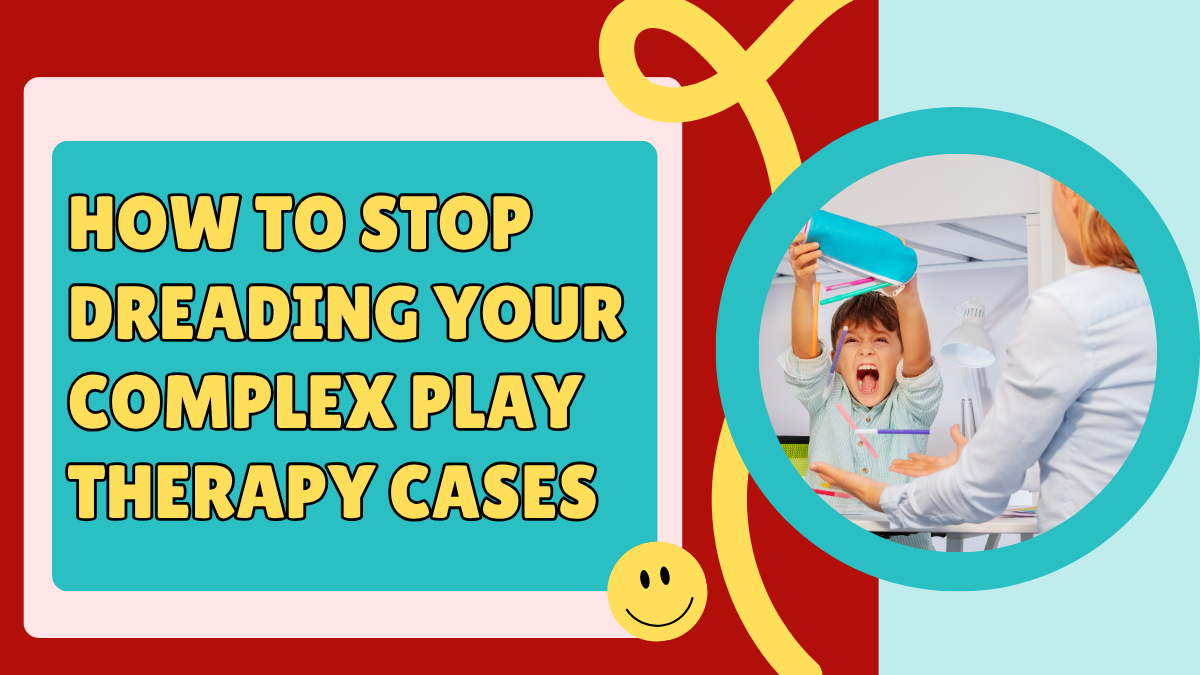
Learn how a clear clinical framework can help you navigate complex play therapy cases with more confidence and less overwhelm.
A clear clinical framework can turn overwhelming cases into ones you can approach with more intention, clarity, and confidence.
We all have those clients.
You see their name on your schedule and immediately feel that little sense of dread.
Maybe it's the child who has wrecked your playroom more than once. Maybe you've tried everything you can think of and still can't seem to get them to engage. Maybe you're working with significant trauma or intense emotional dysregulation, and you're not sure whether what you're doing is actually helping.
Or maybe the child isn't the part that feels challenging at all.
Maybe it's the parent who calls between sessions with what I call the "911 distress calls" because things are falling apart at home. They're worried play therapy isn't working, they're looking to you for answers, but you can't get them to come in for parent sessions so you can actually work through what's happening.
These are the cases we tend to label challenging or complex.
But I've been thinking about that word challenging lately.
After almost 35 years in the child and adolescent mental health field—and after countless conversations with play therapists—I don't think the presenting problem is always what makes a case feel challenging.
Sometimes, the bigger issue is that we don't have a clear framework for understanding what we're seeing or deciding what to do next.
And that distinction matters.
What Makes a Play Therapy Case Feel Challenging?
We usually define a challenging case by what's happening externally.
The trauma is severe.
The child's dysregulation is intense.
The family system is complicated.
The parent is overwhelmed, anxious, or difficult to engage.
The child isn't responding the way we expected.
All of those things absolutely affect treatment. But here's something I've noticed over the years:
The exact same case that feels overwhelming to one play therapist may not feel overwhelming to another.
Why?
It isn't necessarily because one therapist is more talented or experienced.
Often, the difference is that one therapist has a clear clinical framework for making sense of what's happening.
When you don't have that framework, everything can feel chaotic.
You're trying to respond to the child's behavior, the parent's concerns, what's happening at school, what happened in the last session, what you learned in your latest training, and the activity you found online last night.
You're juggling all of these individual pieces without knowing exactly how they fit together.
But a clinical framework begins to organize that chaos.
Instead of asking only, "What should I do with this child?" you can start asking more useful questions:
What stage of the play therapy process is this child in?
What does the therapeutic relationship need right now?
How does my play therapy model tell me to show up?
What should I be looking for as indicators of progress?
What is this behavior communicating?
Suddenly, the case isn't a test with no answer key anymore.
It's a puzzle—and you have a way to begin figuring out where the pieces belong.
Your Mindset Changes How You Show Up
I think we also have to pay attention to the story we're telling ourselves about the case.
If I continually think:
This client is so difficult.
I have no idea what to do.
Nothing is working.
I'm dreading this session.
That mindset is going to influence how I walk into the playroom.
We're human. We all have these reactions sometimes.
But our job is to become curious about them rather than allowing them to drive our clinical decisions.
Because once we decide a case is simply "too challenging," it's very easy to start thinking about referring the client out.
There are absolutely times when referring is clinically and ethically appropriate. But I think we need to be careful that we're not referring simply because we feel uncomfortable or don't know what to do next.
Sometimes the answer isn't immediately sending the case somewhere else.
Sometimes the answer is getting clearer about the case, returning to our clinical framework, and getting consultation from people who can help us think it through.
Start With Case Conceptualization
If you've listened to me for any amount of time, you probably knew I was going here.
Case conceptualization.
I talk about it all the time because it influences so much of what we do.
And case conceptualization isn't something you complete during the initial psychosocial assessment, put in the client's file, and never look at again.
It's an ongoing clinical process.
I think of it like a GPS.
At the beginning, you're developing a hypothesis about where you are and what's at the root of the problem. Then, as you continue working with the child and family, you're constantly receiving new information.
Every play therapy session gives you information.
Every conversation with a caregiver gives you information.
A child's meltdown gives you information.
A difficult phone call from a parent gives you information.
Even a session that feels like absolutely nothing happened gives you information.
Your job is to take that new information and continually update your case conceptualization.
Instead of reacting only to the external behavior, you're asking:
Why is this happening?
What might be at the root of the child's struggle?
What patterns are maintaining it?
What is the behavior communicating?
What new information did I learn today?
That's very different from simply asking, "What activity should I do next?"
Your Play Therapy Model Gives You the Map
Once you have a clearer case conceptualization, your play therapy model helps guide what you actually do with that information.
Different play therapy models are going to make sense of what happens in the playroom differently.
A Child-Centered Play Therapist may conceptualize and respond to something differently than an Adlerian Play Therapist.
A Gestalt Play Therapist may approach it differently than someone using cognitive behavioral approaches, EMDR, or parts work.
That's not a problem.
That's what theoretical models are supposed to do.
Your theoretical lens influences how you understand what's at the root of the problem. Then your play therapy model helps determine things like which interventions make sense, whether your approach is directive or nondirective, how caregivers are involved, what progress looks like, and ultimately what you're going to do, when you're going to do it, and how you're going to do it.
This is where the clinical decision-making process starts becoming much clearer.
Get Away From the Spaghetti-Against-the-Wall Method
When our case conceptualization isn't clear, there's a pattern I see play therapists fall into over and over again.
I call it the spaghetti-against-the-wall method.
We're trying one activity after another, hoping something finally sticks.
Maybe we remember something from a training.
Then we find something on Google.
Then we try a different intervention we saw someone talking about online.
Then we buy another book.
The problem isn't that any of those interventions are necessarily bad.
The problem is that we haven't clearly answered why we're using them.
An activity by itself isn't going to solve a complex clinical case.
Instead of starting externally with "What activity should I use?", I want us to move internally first:
What's actually happening with this child?
What's at the root of the behavior?
What does my case conceptualization tell me?
What does my play therapy model tell me?
Then we choose what we do next.
When we come back to those foundations, we stop white-knuckling our way through sessions and start practicing with much more intention.
Community Is Part of the Framework Too
There's another piece of this that I don't think we can overlook:
We aren't supposed to figure out complex cases alone.
I see the difference community makes constantly in both Play Therapy Academy and Play Therapy Elevation Circle.
Someone brings a case to consultation feeling completely overwhelmed.
We slow it down.
We look at the case conceptualization.
We figure out what might be at the root of the problem.
We look at the therapist's play therapy model.
We consider what stage of treatment the client is in.
Other therapists bring their perspectives and experiences into the conversation.
And something that initially sounded like:
"I don't know if I can handle this case."
starts sounding like:
"Okay. I see what's happening now. I know what I can try next."
And usually they don't leave with only one idea.
They have a Plan A, Plan B, and sometimes Plans C and D.
That is very different from walking into a session hoping something works.
A clinical framework gives you direction.
Community gives you people who can help you use that framework when you're too close to the case to see something clearly.
We need both.
Complex Doesn't Have to Mean Dread
A complex case may still be complex.
A clinical framework isn't going to magically remove a child's trauma, change an entire family system, or make every parent interaction easy.
What it changes is how you navigate the complexity.
You can walk into the playroom understanding what stage of play therapy you're in.
You understand your role.
You know whether your model calls for you to direct, follow, or move between the two.
You know what you're looking for.
You know why you've chosen an intervention.
You have a clearer understanding of how you'll recognize progress.
And when something unexpected happens—as it inevitably will—you have a foundation to return to.
That changes the question from:
"What in the world am I supposed to do?"
to:
"What is this telling me, and what does my framework tell me to do next?"
That's a very different way to practice.
And it's one that allows us to approach even complex play therapy cases with more intention, curiosity, and confidence.
Want to Go Deeper? Join My Free Play Therapy Webinar
If you recognize yourself in this—especially if you're tired of second-guessing every decision when a case gets complicated—I'm going much deeper into this topic in my upcoming free webinar:
How to Provide Play Therapy Without Second-Guessing Every Clinical Decision, Even With Complex Cases
The webinar is August 23 and is completely free.
During this 90-minute training, I'm going to walk you through the clinical decision-making process in more depth and use a case example so you can see how the pieces come together.
We'll look at how having a clear framework can help you move away from constantly wondering whether you're doing the "right" thing and toward making clinical decisions with greater intention and confidence.
Because the goal isn't to reach a point where you never encounter another challenging case.
You will.
We all do.
The goal is to develop a framework—and have the support—that allows you to look at that case and think:
I may not have every answer yet, but I know how to figure out what comes next.
Categories: : Community, Play Therapy Academy, Play Therapy Elevation Circle, Podcast, Supervision