Can Play Therapy Work With Teens
 Cathi Spooner
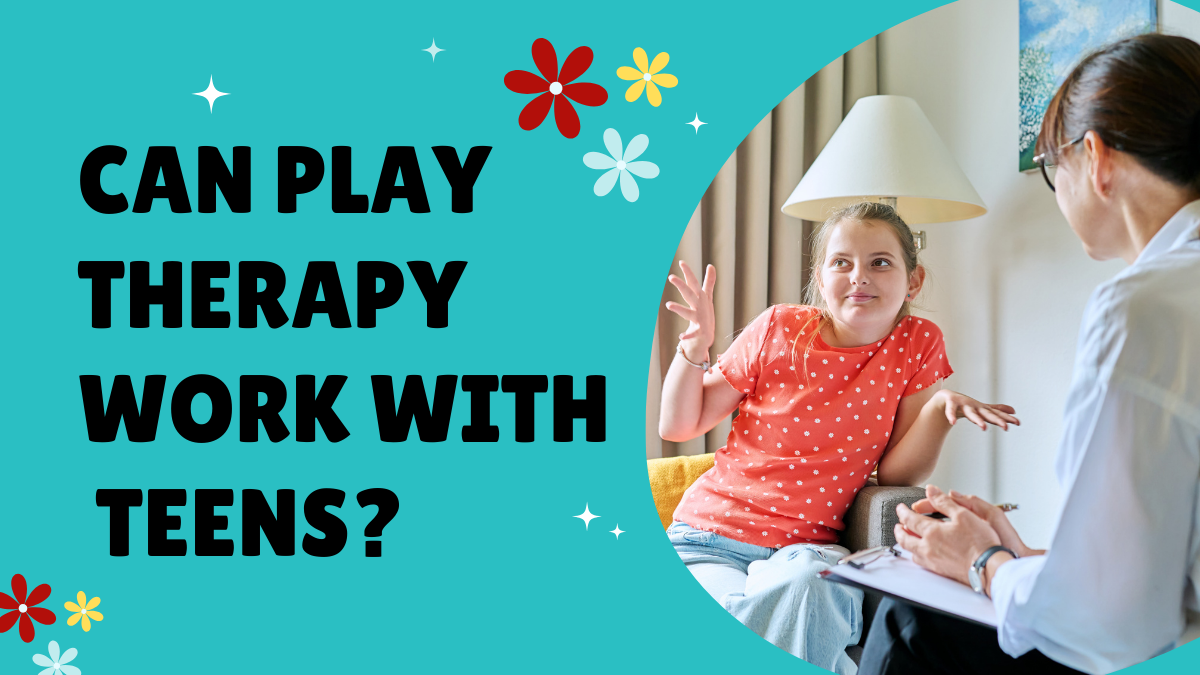
Let’s talk about something that creates a lot of stress for play therapists.
And honestly? For any mental health professional working with adolescents.
You have a teenage client sitting across from you. Hoodie pulled up. Arms crossed. Blank stare.
You ask a thoughtful, open-ended question.
They respond:
“I don’t know.”
Or worse…
Silence.
You try again. Another question.
“I don’t remember.”
Now you’re watching the clock. You’re feeling anxious. You’re wondering:
-
Is play therapy even appropriate for teens?
-
Are they “not ready” for therapy?
-
Am I doing something wrong?
If that sounds familiar, you are not alone. I’ve been there. We all have.
And here’s the part that might feel counterintuitive:
Stop trying to get them to talk about their feelings.
Why Talking Doesn’t Work (Sometimes)
Graduate school trains us in talk therapy models. Insight. Reflection. Emotional labeling. Cognitive restructuring.
So when a teen shuts down, our instinct is to try harder.
More rapport-building.
More open-ended questions.
More attempts to get them to “open up.”
But here’s what’s actually happening neurologically.
Adolescents are developmentally in-between. Their prefrontal cortex — the part responsible for insight, reflection, and emotional regulation — is still developing. It won’t fully mature until their mid-20s (sometimes later).
Now layer in trauma, anxiety, depression, or overwhelm.
When they’re emotionally flooded, those higher cognitive areas go offline.
So when we ask them to:
-
Identify complex emotions
-
Connect thoughts to behaviors
-
Reflect insightfully on experiences
We are asking them to use brain regions they literally cannot access in that moment.
And what happens?
Shutdown.
Silence.
“I don’t know.”
It’s not resistance.
It’s overload.
I don’t even use the word “resistant” anymore. I prefer reluctant. Reluctant tells me something is happening in their nervous system. Something doesn’t feel safe yet.
And if I keep pushing? I make it worse.
What to Do Instead: Bypass the Cognitive Bottleneck
When teens can’t talk, we need to stop requiring verbal processing.
This is where expressive arts and play therapy shine.
Years ago, William Steele described something called iconic synchronization — giving symbolic form to experiences that can’t yet be accessed cognitively.
When we use:
-
Sand tray
-
Clay
-
Art
-
Movement
-
Poetry
-
Symbolic miniatures
We allow the teen to externalize what’s happening internally — without requiring words.
We bypass the prefrontal cortex bottleneck.
We go through the right brain.
Through implicit memory.
Through symbolic representation.
And here’s the magic:
Once it’s in the sand tray…
Once it’s on the paper…
Once it’s shaped in clay…
Now we can gently explore it.
Not interrogate.
Not analyze.
But wonder.
“What might that represent?”
“What do you notice about how that feels?”
Sometimes they’ll talk.
Sometimes they won’t.
And that’s okay.
Because healing is happening in the process.
I’ve Seen This Work (Over and Over)
I once supervised a therapist working with a preteen with selective mutism.
For nearly a year, this child barely spoke in session.
But every week?
Sand tray.
Themes emerged. Depth emerged. Trauma processed symbolically.
Parents reported changes at home.
The child was healing — without talking.
That’s the therapeutic powers of play.
It’s not the talking that heals.
It’s the process.
The Mistake Most Therapists Make
When we don’t have a framework, we panic.
We start Googling activities.
We try one thing, then another.
It becomes what I call the “spaghetti against the wall” method.
There’s no structure.
No grounding lens.
No intentional sequencing.
And that’s when you start feeling lost and questioning your skills.
Teens don’t need more questions.
They need:
-
Safety
-
Regulation
-
Symbolic expression
-
A therapist grounded in a theoretical framework
Why I Created This Training
This exact struggle is why I created:
Play Therapy with Adolescents Using Expressive Arts
In this training, I walk you through:
-
The neuroscience behind adolescent shutdown
-
Attachment and interpersonal neurobiology
-
How to conceptualize teen cases through a regulation lens
-
An integrative play therapy framework
-
When and how to use expressive arts intentionally
-
Experiential exercises you can use immediately
And because I believe training alone isn’t enough…
Every new registrant receives 2 months inside Play Therapy Elevation Circle.
Why?
Because learning something once isn’t the same as applying it with real clients.
Community is where integration happens.
It’s where you bring the stuck teen case.
It’s where you ask, “Okay… now what?”
And you don’t have to figure it out alone.
Your Options
You can attend:
-
In person (St. George, Utah)
-
Virtually live
-
Or register for the recorded version (perfect for international time zones)
The recording is professionally edited into modules and drops into your account about a week after the live training.
And yes — the 2 months of Elevation CIRCLE is included for all new members registering for any 2026 training.
Final Thought
If you’re sitting across from a silent teen and feeling stuck…
You’re not failing.
You’re just trying to use the wrong door.
Stop pushing for words.
Give them symbolic space.
Trust the process.
And if you want support in learning how to do that well, I’d love to see you inside the training.
Head over to:
rhplaytherapytraining.com → Trainings
Or message me with questions.
You don’t have to do this alone.
Categories: : Adolescents in Play Therapy, Art in Play Therapy, Community, Expressive Arts, Play Therapy, Play Therapy Academy, Play Therapy Elevation Circle, Podcast, Supervision