Beyond Labeling: Why Emotional Granularity is the Key to Resilience in Play Therapy
 Cathi Spooner
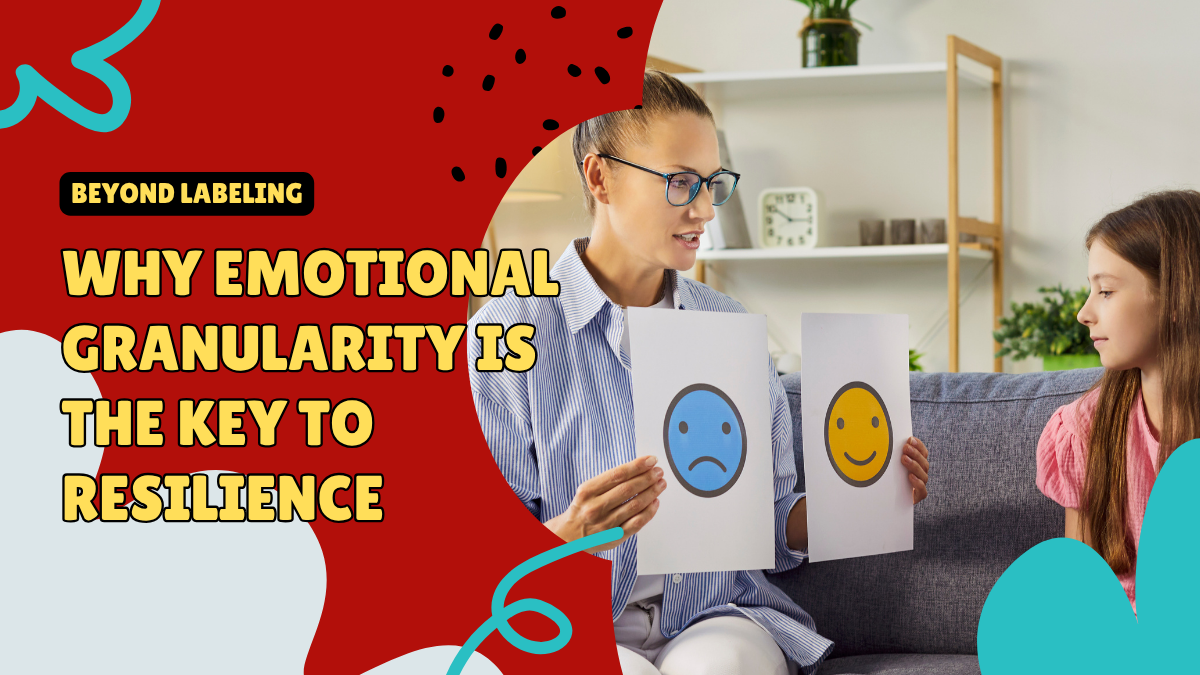
Helping children move beyond “good” and “bad” feelings so they can build emotional resilience, improve regulation, and heal more effectively
One of the things we talk about all the time in play therapy is helping children identify and label emotions.
And that matters.
Helping children recognize feelings is an important part of the therapeutic process.
But lately, I’ve been thinking more deeply about this question:
What if we stop too soon?
Because sometimes I wonder if we unintentionally over-focus on helping children “feel good” instead of helping them become resilient.
And those are not the same thing.
In this week’s episode of Next Level Play Therapy, I explored the concept of emotional granularity and why I believe it is one of the missing pieces in many play therapy treatment plans.
What Is Emotional Granularity?
Emotional granularity is the ability to:
- Recognize emotions
- Differentiate emotions
- Label emotions accurately
- Understand the nuances between emotions
Instead of simply saying:
- “I feel bad”
- “I feel upset”
- “I feel fine”
A child with higher emotional granularity can identify more specific internal experiences such as:
- Frustrated
- Disappointed
- Embarrassed
- Rejected
- Lonely
- Ashamed
- Overwhelmed
- Nervous
- Uncertain
Research suggests that higher emotional granularity is associated with:
- Better mental health outcomes
- Improved emotion regulation
- Increased resilience
- Reduced maladaptive coping behaviors
And honestly, that makes a lot of sense clinically.
Because when children can better understand what they are experiencing internally, they are more capable of responding intentionally rather than reacting impulsively.
Why “Feeling Happy” Is Not the Goal
One of the concerns I shared in this episode is that sometimes we unintentionally communicate this idea that therapy should help children feel happy all the time.
But that is not realistic.
No one feels good all the time.
The goal is not emotional perfection.
The goal is resilience.
I want children to develop the capacity to:
- Tolerate difficult emotions
- Understand their emotional experiences
- Recognize what their emotions are communicating
- Navigate hard situations without becoming overwhelmed
That is very different from trying to avoid discomfort altogether.
Affect vs. Emotion: Why the Difference Matters
One of the concepts I explored in this episode comes from affective neuroscience researcher Lisa Feldman Barrett and her work on how emotions are constructed.
She distinguishes between:
- Affect — a basic sense of feeling pleasant or unpleasant
- Emotion — a more complex experience shaped by meaning, experience, culture, personality, and interpretation
This matters because two children can experience the same event very differently.
For example:
- One child may experience rejection and conclude, “Nobody likes me.”
- Another child may experience the same event and think, “That hurt, but I’ll find another friend.”
Same situation.
Different meaning-making.
Different emotional response.
That’s why helping children simply label emotions is not enough.
We also need to help them understand:
- What triggered the emotion
- What beliefs are connected to it
- What meaning they are making from the experience
Why Emotional Granularity Matters in Play Therapy
As play therapists, we are not helping children identify emotions just for the sake of identifying them.
We are helping them:
- Improve regulation
- Increase self-awareness
- Strengthen communication
- Develop resilience
- Understand internal experiences
- Build healthier responses
And our play therapy model influences how we do that.
For example:
- Child-Centered Play Therapy approaches emotional exploration differently than
- CBT Play Therapy
- Adlerian Play Therapy
- EMDR
- Gestalt Play Therapy
Your theoretical framework matters because it shapes:
- How you conceptualize emotional experiences
- What interventions you use
- How you interpret play themes
- How you help children process emotional experiences
One of the Biggest Mistakes I See
One of the biggest mistakes I see in play therapy is focusing only on behavior.
Parents are understandably distressed by behaviors like:
- Aggression
- Emotional outbursts
- Withdrawal
- Self-harm
- School refusal
- Anxiety-driven behaviors
And when the focus stays only on behavior reduction, we often miss what is happening underneath.
Behavior is communication.
And emotional granularity helps us understand:
- What emotional experiences are driving the behavior
- What beliefs are attached to those emotions
- What needs are underneath the emotional response
Especially when trauma is involved.
Trauma Changes Emotional Processing
When working with traumatized children, emotional experiences often become tied to threat perception and survival responses.
Children may not simply feel:
- Angry
- Sad
- Nervous
Instead, their nervous systems may interpret situations as dangerous based on past experiences.
That means emotional work in play therapy is not just about “calming down.”
It is about helping children:
- Recognize emotions accurately
- Distinguish between real threat and perceived threat
- Reprocess emotional experiences
- Build a greater sense of safety
This is why emotional granularity becomes so important in trauma work.
Why I Don’t Love Emotion Wheels
I shared something in this episode that may surprise some people:
I’m honestly not a huge fan of many traditional emotion wheels.
Not because they are inherently bad.
But because many of them feel:
- Overcrowded
- Overly restrictive
- Too cognitively demanding
- Not flexible enough for nuanced emotional exploration
Children often experience multiple layered emotions at once.
Sometimes:
- Anger is covering sadness
- Irritability is masking fear
- Withdrawal is connected to shame
I prefer approaches that allow children to explore emotional experiences more openly and creatively.
How Play Therapy Supports Emotional Granularity
This is one of the reasons play therapy is so powerful.
Children often communicate emotions through:
- Symbolic play
- Sand tray
- Art
- Storytelling
- Role play
- Movement
- Metaphor
Play gives children a safer and more developmentally appropriate way to explore internal experiences that may be difficult to verbalize directly.
And through the therapeutic powers of play, children can:
- Externalize emotions
- Explore emotional themes
- Reprocess difficult experiences
- Build new emotional understanding
Without relying solely on cognitive insight.
Why Parents Need Emotional Granularity Too
One of the things I emphasize often is this:
Parents need emotional granularity too.
Because if caregivers cannot recognize and regulate their own emotional experiences, co-regulation becomes much more difficult.
Parents who become emotionally activated may unintentionally:
- Escalate situations
- Misinterpret behavior
- Respond from their own unresolved emotional experiences
This is why parent consultation and caregiver support are such important parts of effective play therapy treatment planning.
Final Thoughts
Helping children identify emotions is important.
But we cannot stop there.
I want children to:
- Understand emotions
- Differentiate emotions
- Explore the meaning connected to emotions
- Build resilience
- Develop regulation skills
- Navigate difficult experiences with greater flexibility and self-awareness
That is the deeper work.
And honestly, I think emotional granularity is one of the keys to helping children move from simple emotional awareness into long-term healing and resilience.
Want to Learn More?
Healing Trauma Through Play Therapy: A Neuroscience and Attachment Approach
In this training, I teach:
- Trauma-informed case conceptualization
- Attachment and neuroscience frameworks
- Emotional regulation strategies
- Trauma processing in play therapy
- Practical interventions for children and teens
Training Options:
Bonus for New Members:
When you register for the training, you’ll also receive 60 days of access to Play Therapy Elevation Circle at no additional cost for new members.
Play Therapy Elevation CIRCLE
Play Therapy Elevation CIRCLE is my ongoing support and consultation community for play therapists who want:
- Monthly consultation
- Clinical discussion
- Book club
- Supportive community
- Ongoing integration and learning
Because play therapists should not have to do this work alone.
Categories: : emotion regulation, Play Therapy, Play Therapy Academy, Play Therapy Elevation Circle, Podcast, Trauma