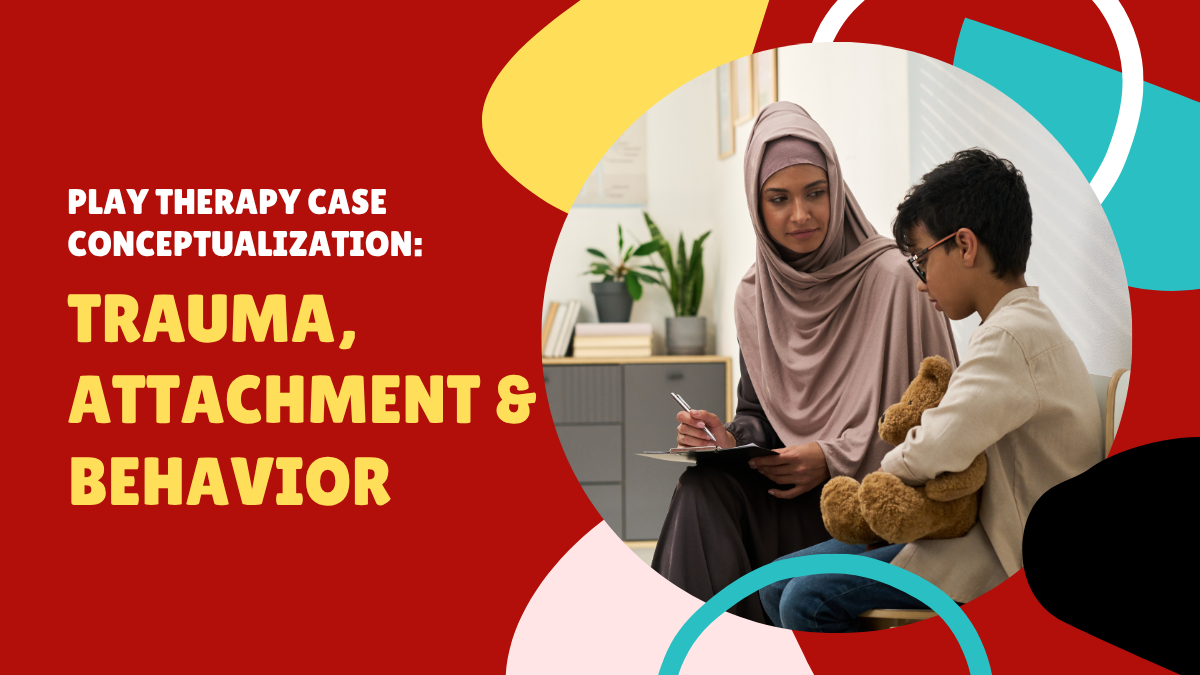
Play Therapy Case Conceptualization: Trauma, Attachment & Behavior
 Cathi Spooner
Stop chasing behaviors in the playroom and start understanding what is actually driving them
If you have ever left a play therapy session thinking:
“I saw the behaviors… but I have no idea what’s actually driving them.”
You are not alone.
In fact, this is one of the most common reasons play therapists feel stuck.
You may see:
- Clinginess
- Shutdown
- Aggression
- Food hoarding
- Room wrecking
- Separation anxiety
- Nightmares
- Avoidance
But if your treatment planning only focuses on stopping the behavior, you may miss the deeper story entirely.
This week on Next Level Play Therapy, Cathi Spooner breaks down one of the most important advanced skills a play therapist can develop:
Case conceptualization.
Because when you understand what is beneath the behavior, everything changes.
Why So Many Play Therapists Feel Stuck
One of the biggest traps in play therapy is staying at the behavioral level.
When this happens, clinicians often start asking:
- How do I stop this behavior?
- How do I get them to talk?
- How do I make bedtime easier?
- How do I stop food hoarding?
- How do I reduce meltdowns?
While those questions make sense, they often lead therapists into what Cathi describes as chasing behaviors instead of understanding them.
Without strong case conceptualization:
You may:
- Second-guess yourself
- Feel directionless
- Jump from activity to activity
- Use “spaghetti against the wall” interventions
- Feel ineffective
- Miss trauma and attachment roots
With strong case conceptualization:
You become:
- More grounded
- More intentional
- More confident
- More clinically effective
What Is Case Conceptualization in Play Therapy?
Case conceptualization is your ability to move beyond surface behaviors and ask:
“What is this behavior trying to solve?”
Or even deeper:
“What need is this child trying to get met?”
This is the difference between reacting to behavior and understanding behavior.
Meet Carla: A Fictitious Case Study
In this episode, Cathi walks listeners through a fictional client named Carla—a seven-year-old girl in foster care after chronic neglect related to parental substance abuse and homelessness.
Carla’s presenting concerns:
- Nightmares
- Bedtime refusal
- Clinginess
- Food hoarding
- Withdrawal
- Separation distress
In the playroom:
- Refuses to separate from caregiver
- Constantly checks for caregiver presence
- Minimal verbalization
- Uses dollhouse play to separate adults and children
At first glance, a therapist might label Carla as:
- Resistant
- Avoidant
- Anxious
- Behaviorally difficult
But case conceptualization asks a much better question:
What if these behaviors are adaptive survival strategies?
The Critical Shift: Behavior as Communication
This is where play therapy becomes more than behavior management.
Instead of seeing Carla’s food hoarding as defiance…
We ask:
“Has food insecurity taught her that her needs may not consistently be met?”
Instead of seeing clinginess as dependency…
We ask:
“Does her nervous system need proximity because safety has been unpredictable?”
Instead of seeing withdrawal as oppositional…
We ask:
“Is shutdown protecting her from overwhelming uncertainty?”
This is the heart of trauma-informed play therapy.
Using a Neuroscience and Attachment Lens
Cathi emphasizes that Carla’s brain is likely not organized around curiosity or exploration.
Instead:
Her brain is organized around survival.
This means her nervous system may be shaped by:
- Chronic instability
- Neglect
- Inconsistent caregiving
- Fear of unmet needs
- Hypervigilance
So her behaviors make sense.
They are not random.
They are protective.
Why Attachment Matters
Through an attachment lens, Carla may have learned:
- Caregivers are inconsistent
- Needs may not be met
- Safety is unpredictable
- Separation may feel dangerous
This changes everything.
Now, her repeated checking for caregiver presence is not simply “clinginess.”
It may be her attachment system doing exactly what it was designed to do:
Maintain enough connection to survive.
Play Themes Reveal Internal Worlds
One of the most powerful parts of this episode is Cathi’s reminder that play themes matter.
When Carla separates children and adults in the dollhouse, this may symbolize:
- Separation
- Disconnection
- Emotional distance
- Attachment disruption
Rather than rushing to interpretation, play therapists can hold these themes as meaningful data.
This is why play therapy is not just “playing with toys.”
It is clinically informed observation rooted in theory.
Your Theoretical Model Shapes Everything
Cathi makes an important point:
Your case conceptualization will always be influenced by your play therapy model.
For example:
Child-Centered Play Therapy:
Focuses on relationship, trust, and the child’s internal process
Adlerian Play Therapy:
May emphasize belonging, mistaken beliefs, and social context
Neuroscience + Attachment Lens:
May prioritize nervous system regulation, felt safety, and developmental disruption
Integrative Models:
May blend EMDR, IFS, expressive arts, sand tray, and attachment-based frameworks
This matters because your model influences:
- What you notice
- What you prioritize
- What you do
- When you intervene
- How you interpret play
The Real Goal: Move From Behavior Reduction to Felt Safety
For Carla, treatment planning should not start with:
“How do we stop the food hoarding?”
Instead:
“How do we help her internalize that her needs will consistently be met?”
Not:
“How do we make her sleep alone?”
Instead:
“How do we create enough safety that separation no longer feels dangerous?”
Not:
“How do we make her engage in play therapy?”
Instead:
“How do we help her nervous system feel safe enough to explore?”
This is advanced clinical thinking.
Why Gathering Full History Matters
One major takeaway from this episode is the importance of not skipping the intake and psychosocial history process.
Cathi strongly emphasizes:
You cannot conceptualize what you do not fully understand.
Missing information can include:
- Foster care history
- Extent of neglect
- Substance exposure
- Domestic violence
- Sexual abuse
- Developmental delays
- Parent-child dynamics
- Visitation patterns
Without this context, therapists may misread trauma adaptations as behavioral problems.
Final Thought: You Cannot Treat What You Have Not Yet Made Sense Of
This episode is a powerful reminder that play therapists do not need more random activities.
They need deeper understanding.
Because when you know what is at the root:
- You stop guessing
- You stop chasing behaviors
- You become more confident
- Your interventions become more targeted
- Healing becomes more possible
Case conceptualization is not extra.
It is foundational.
Want to Go Deeper?
Healing Trauma Through Play Therapy: A Neuroscience and Attachment Approach
Cathi’s upcoming training explores:
- Trauma and neglect through a neuroscience lens
- Attachment-informed treatment planning
- Play therapy stages
- Case conceptualization
- Practical interventions
- Working with caregivers
Registration Includes:
- Virtual
- In-person (St. George, Utah)
- Recorded option
- 60 days of Play Therapy Elevation Circle for new members
Register for the training here.
Play Therapy Elevation Circle
For therapists seeking ongoing support, case staffing, book club, and community. Enroll here.
Play Therapy Academy
For therapists ready to develop deeper competency, confidence, and advanced play therapy skill mastery. Schedule a free 30 minute call here.
Categories: : Case Conceptualization, emotion regulation, Play Therapy, Play Therapy Academy, Play Therapy Elevation Circle, Podcast, Trauma