Congruence & Co-Regulation in Play Therapy
 Cathi Spooner
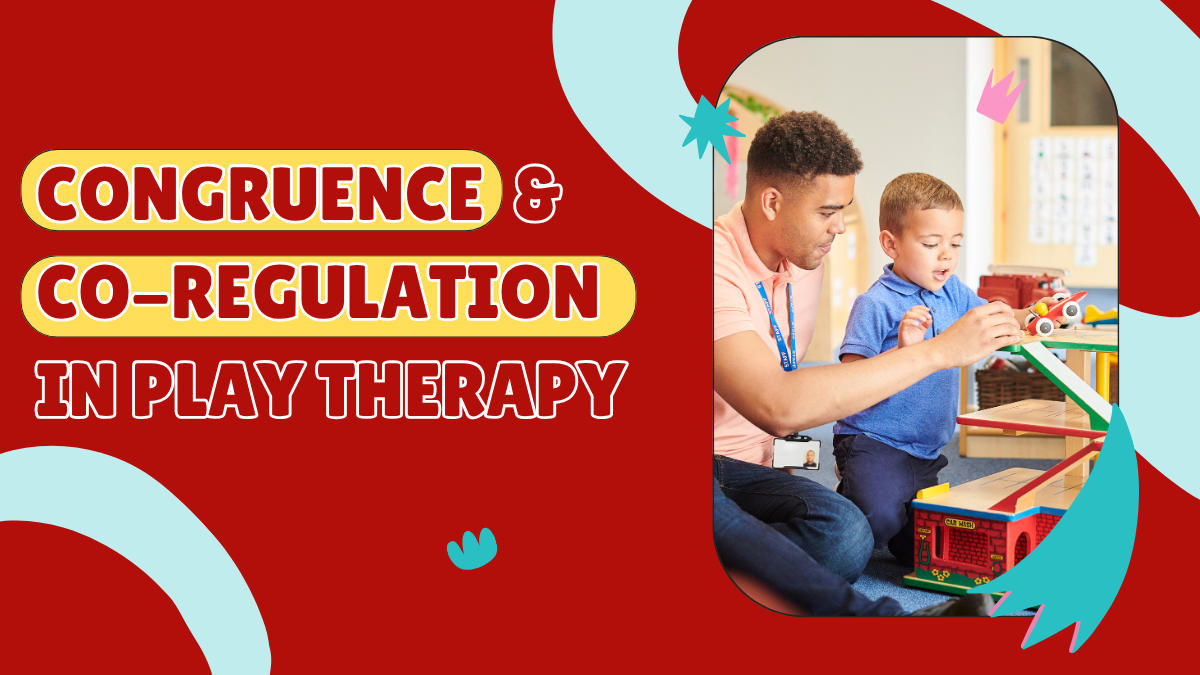
Explore how congruence, self-awareness, and your own regulation influence co-regulation and therapeutic presence in play therapy.
How self-awareness, authenticity, and your own regulation shape the therapeutic relationship and your ability to co-regulate with children
As play therapists, we spend a lot of time thinking about our clients' nervous systems.
Is this child regulated?
Are they outside their window of tolerance?
What is activating them?
What do they need from me right now?
But there's another nervous system in the playroom that we need to pay attention to.
Ours.
I've been thinking a lot lately about two concepts that I don't often see discussed together: congruence and co-regulation.
In my mind, they're deeply connected.
Because if I'm going to use myself therapeutically to help a child move from a highly activated—or perhaps shut-down—state into a more regulated state, I first need to understand what's happening inside of me.
Am I regulated?
Am I genuinely feeling empathy and unconditional positive regard toward this child?
Or am I simply trying to look calm and therapeutic while something very different is happening internally?
That's where congruence comes in.
And I think understanding the connection between congruence and co-regulation gives us another way of thinking about what therapeutic use of self really means in the playroom. Ep 140-congruence-co-regulation…
Congruence Isn't Performing Calm
At its core, congruence is about matching what we're experiencing internally with what we're expressing externally.
That means we're not simply performing calm.
We're not performing warmth.
We're not performing empathy because that's what a therapist is supposed to look like.
We're showing up authentically and intentionally in the therapeutic relationship.
When I can genuinely access unconditional positive regard and empathy internally, those things are naturally communicated externally through my presence, facial expressions, body language, tone of voice, and the way I interact with my client.
And children notice the difference.
Teenagers definitely notice the difference.
If I'm saying all the therapeutically correct things while my nonverbal communication is telling an entirely different story, an attuned client may pick up on that discrepancy.
That's why congruence requires more than learning the right therapeutic responses.
It requires knowing what's happening inside of ourselves. Ep 140-congruence-co-regulation…
We Don't Turn Into Robots When We Enter the Playroom
Sometimes I think we expect ourselves to walk into a therapy session and somehow turn off all of our human responses.
But we're still human.
We bring a nervous system into the room.
We have emotions.
We have beliefs.
We have histories and experiences.
And things happen in sessions that activate us.
Years ago, I was struggling with something I was feeling, and my husband—who isn't a therapist and tends to be very practical—basically said:
“Well, you're human. Of course you're going to feel that way.”
And I remember thinking:
Oh. Yeah.
Sometimes therapists can be incredibly hard on ourselves.
Self-awareness is absolutely important because of the responsibility we carry in the therapeutic relationship.
But self-awareness is different from expecting ourselves to never have an uncomfortable emotional response to a client.
The goal isn't to eliminate our humanity.
The goal is to notice what's happening internally and understand how it may be affecting the way we're showing up. Ep 140-congruence-co-regulation…
Your Internal Experience Is Giving You Information
This is where I've been connecting some of what I've been exploring around neuroscience and the theory of constructed emotion with therapeutic use of self.
We can also think about it through a CBT or DBT lens.
What's happening with my thoughts?
What beliefs are being activated?
What emotions am I experiencing?
And how might those things influence my behavior?
Because if I can't genuinely access empathy and unconditional positive regard toward my client, that's important information.
I don't need to shame myself for it.
But I do need to notice it.
If the therapeutic relationship itself can become part of a corrective healing experience for our clients, then what happens within that relationship matters.
And that includes what's happening inside the therapist. Ep 140-congruence-co-regulation…
What Happens When You Don't Like Your Client?
Let's talk about something we probably don't say out loud enough.
Have you ever been sitting in a session thinking:
“I really don't like this client right now.”
Maybe you don't even know why.
There's just something about the child that irritates you.
Now what?
It's easy for our next thought to become:
I'm a terrible play therapist.
I shouldn't feel this way.
What's wrong with me?
But now we've added shame and guilt on top of the original emotional response.
And none of that is particularly helpful when we're trying to stay present with a child.
Instead, I want to move toward curiosity.
Huh. That's interesting. What's happening here?
Maybe I can't figure it out during the session.
That's okay.
I can recognize that something is happening without needing to solve it immediately.
Maybe I'm picking up on something relationally.
Maybe something in me has been activated.
Maybe it's both.
Perhaps the feeling I'm experiencing is similar to what other people experience around this child—and maybe that information eventually helps me better understand why this child struggles in relationships.
I can explore all of that later.
In the moment, this child still needs me to show up therapeutically.
So instead of beating myself up, I can notice the response, set it aside temporarily, and return to the child in front of me.
Curiosity gives me somewhere to go that shame doesn't. Ep 140-congruence-co-regulation…
This Is Where Congruence Connects to Co-Regulation
Now we get to the connection between these two concepts.
If I'm becoming increasingly activated during a session and moving outside my own window of tolerance, what happens to my ability to co-regulate my client?
It becomes much harder.
That's why I think self-awareness, congruence, and co-regulation are so interconnected.
I need to recognize:
Something is happening inside me.
Then I need to be able to take whatever steps are necessary to return to a more regulated state.
When I can remain regulated and authentically access empathy and unconditional positive regard, I'm in a much better position to help my client move from a highly activated emotional state toward regulation.
The same is true when a child has moved toward shutdown.
We have to be aware of our own regulated state and be able to access congruence in order to effectively co-regulate. Ep 140-congruence-co-regulation…
Co-Regulation Is Part of the Therapeutic Work
Imagine a parent manages to get their child to your office in the middle of a really difficult emotional episode.
The child is furious.
They're swearing in the lobby.
Maybe they're knocking things over.
The parent is overwhelmed.
It would be easy to think:
We're never getting into the playroom today.
But I don't necessarily see that as a wasted session.
I see a therapeutic opportunity.
In that moment, I'm thinking about how I can help the parent stay regulated enough to co-regulate their child.
I may be co-regulating with the parent while the parent co-regulates with the child.
And I'm holding space for both of them.
We don't necessarily need to figure out what activated the meltdown right then.
There will be time for that later.
Right now, the work is regulation.
If it takes the entire session, then it takes the entire session.
That doesn't mean therapy didn't happen.
That was the therapeutic work that needed to happen that day. Ep 140-congruence-co-regulation…
Parents Need These Skills Too
This is also why parent work is such an important part of how I think about play therapy.
During parent-only sessions, we can help caregivers develop the same kind of self-awareness we're working on as therapists.
What happens inside you when your child becomes dysregulated?
What emotions come up?
What are you telling yourself?
What beliefs are being activated?
How do those internal experiences influence the way you respond to your child?
Can you get yourself into a regulated enough state that you can access empathy and unconditional positive regard for your child—even when their behavior is incredibly difficult?
And then, from that place, can you co-regulate?
That doesn't mean there are no boundaries.
Co-regulation does not mean no limit setting.
We can still set necessary limits while remaining relationally available.
But first, we have to help the parent recognize what's happening inside themselves so they can respond intentionally instead of simply reacting to the child's emotional state. Ep 140-congruence-co-regulation…
Your Client Isn't the Only One With a Window of Tolerance
We've talked recently about the child's window of tolerance and what that can look like in the playroom.
But therapists have one too.
So do parents.
That's why part of therapeutic use of self is learning to recognize when we're moving outside ours.
Maybe you're becoming irritated.
Maybe you're anxious.
Maybe you're shutting down.
Maybe you're thinking:
I need this session to be over.
That's information.
Can you notice it?
Can you recognize the beliefs and emotions connected to it?
Can you bring yourself back toward a regulated state?
That ability matters because your internal state influences your capacity to remain attuned and authentically present with your client.
And ultimately, it influences your ability to offer the co-regulation your client may need. Ep 140-congruence-co-regulation…
Therapeutic Presence Takes Energy
There's another part of this conversation that I think we need to acknowledge.
Doing this over and over again is exhausting.
Session after session, we're trying to remain present.
We're paying attention to our clients.
We're monitoring ourselves.
We're maintaining empathy.
We're holding space for intense emotions.
We're setting limits.
We're making clinical decisions.
We're working with parents.
Some sessions are easier than others.
And then there are the really hard ones.
Those sessions affect us.
We're not machines.
And if we're doing this day after day without paying attention to our own capacity, eventually that is going to influence how we're able to show up.
That's why I don't think self-care is separate from therapeutic use of self.
It's part of it. Ep 140-congruence-co-regulation…
You Can't Give What You Don't Possess
We use the airplane oxygen-mask analogy with parents all the time.
If the oxygen masks drop, you're instructed to put your own mask on before helping your child.
Why?
Because if you pass out, you're not going to be very useful to the person sitting next to you.
The same principle applies here.
I sometimes say:
You have to fill your own well.
If your well is empty, you don't have much left to give.
And this can be difficult for therapists because we have lives outside the playroom too.
We have families.
Relationships.
Responsibilities.
Stress.
I remember periods when my own kids were younger when I felt like I sometimes showed up better for my clients than I did for my family because I didn't have much left by the time I got home.
And I felt guilty about that.
But that's also part of why we need to pay attention to our capacity.
If therapeutic use of self is one of the tools we bring into our work, we have to take care of that tool. Ep 140-congruence-co-regulation…
Self-Care Doesn't Have to Mean Doing It All Yourself
Self-care is often framed as something else we're supposed to accomplish individually.
Exercise.
Meditate.
Sleep more.
Take a vacation.
Those things may be helpful.
But for me, one of the most important forms of support has been other people.
There were times when I needed colleagues who could help me work through a difficult case.
Sometimes I needed someone to help me understand what happened in a session.
Sometimes I needed a friend I could vent to about life.
Sometimes I needed help carrying the load.
We cannot do this work completely alone.
And I think having a play therapy-specific community can be particularly valuable because the people around you understand the language of the work.
You have somewhere safe and nonjudgmental to explore:
What happened in that session?
Why did that affect me so much?
Was that mine? Was it the client's? Was it both?
What does my play therapy model tell me?
What should I do next?
Sometimes you need other people to think alongside you. Ep 140-congruence-co-regulation…
Congruence Isn't About Being a Perfect Play Therapist
I don't want this conversation about congruence to become another reason to expect perfection from ourselves.
The goal isn't:
Never become irritated.
Never feel overwhelmed.
Never dislike something your client does.
Never become activated.
That's not realistic.
We're human.
The work is noticing.
Can I recognize my internal response without immediately judging myself for having it?
Can I become curious about what it's telling me?
Can I determine whether it's mine, the client's, or something happening relationally between us?
Can I return to a regulated enough state to be present with this client?
Can I access empathy and unconditional positive regard authentically?
And when I can't figure it out in the moment, can I get support afterward?
That's the work.
Congruence isn't pretending you don't have an internal response. It's becoming aware enough of that response that it doesn't unconsciously run the session.
Your Regulated Presence Is Part of the Intervention
We tend to think of interventions as the things we do.
The activity.
The toy.
The reflection.
The limit-setting technique.
The carefully planned intervention we brought into the session.
But sometimes one of the most important things we're bringing into that room is our way of being.
Our presence.
Our attunement.
Our ability to stay within our own window of tolerance.
Our ability to recognize what's happening inside ourselves.
And our capacity to authentically offer empathy and unconditional positive regard to the child in front of us.
That's therapeutic use of self.
And when we can show up congruently and stay regulated enough to hold space for our clients' difficult emotional experiences, our presence becomes part of the co-regulation process. Ep 140-congruence-co-regulation…
You Don't Have to Carry the Therapeutic Load Alone
This is one of the reasons community is such an important part of both Play Therapy Elevation CIRCLE and Play Therapy Academy.
Inside Play Therapy Elevation CIRCLE, we focus on giving play therapists a place to get support, ask questions, discuss cases, and have other play therapists think alongside them. We have monthly consultation calls, a Monthly Book Club, quarterly roundtable discussions, and weekly tips and ideas you can use in your work.
Enrollment for PTEC is currently closed, but you can join the waitlist through the Renewing Hearts Play Therapy Training website.
If you're looking for deeper skill-building, Play Therapy Academy focuses on helping you develop your play therapy competency throughout each stage of the therapeutic process.
We work on case conceptualization, identifying what's at the root of the problem and the patterns sustaining it, recognizing what's happening in the playroom, applying your specific play therapy model, and using that information to decide what to do next.
Play Therapy Academy is a much smaller group, with a maximum of 10 people, and spots have recently opened.
If you're tired of second-guessing yourself or feeling like you're throwing play therapy activities against the wall hoping something sticks, you can schedule a 30-minute video call with me to talk about whether Play Therapy Academy—or Play Therapy Elevation CIRCLE—would be the better fit.
Because becoming a more confident play therapist doesn't mean learning how to carry all of this by yourself.
Sometimes part of growing clinically is recognizing that you don't have to.
Categories: : Co-regulation, Community, Congruence, Consultation, Play Therapy Academy, Play Therapy Elevation Circle, Podcast, Supervision