Family Play Therapy: Why Treating Just the Child Limits Outcomes
 Cathi Spooner

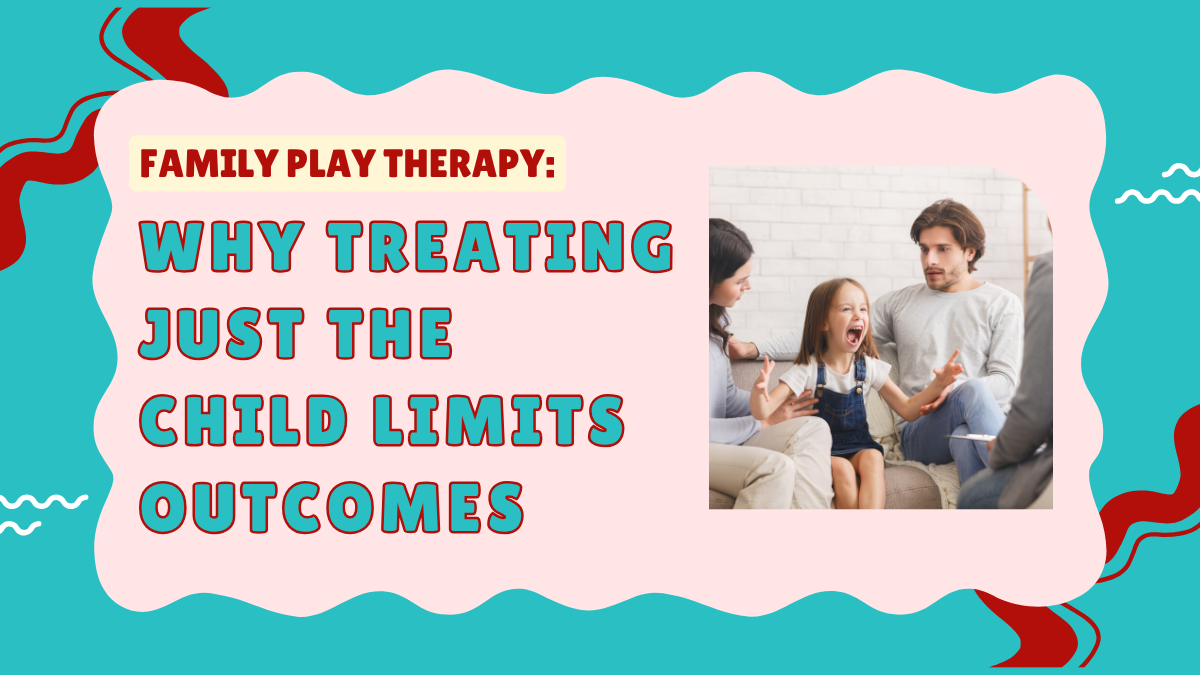
Learn why individual play therapy can hit a ceiling and how family play therapy can help create sustainable change beyond the playroom.
When progress in the playroom isn't translating home, it may be time to look beyond the child and into the family system
Have you ever had a child who seems to be making progress in the playroom, but the parents keep telling you, “Nothing is changing at home”?
Inside your sessions, things seem to be moving. You're noticing changes in the child's play, the therapeutic relationship is developing, and maybe you're even seeing signs that the child is regulating more effectively. From your perspective, the work you're doing together seems to be having an impact.
But then the parent calls. Or sends another email. Or you squeeze in one of those five-minute check-ins at the end of the session that is never actually five minutes. And you're hearing about all the things that still aren't working—the meltdowns, the arguing, the sibling conflict, the child refusing to do what they're asked.
You've given the parents strategies. They tell you they're using them. And maybe somewhere in the back of your mind you're wondering, Are they really doing what we talked about? Did they try it more than once? Did they stop the minute it got difficult?
Maybe. But there's another possibility we need to consider: maybe we're missing something about what's happening in the family system.
Individual play therapy is incredibly powerful, but there are times when it can reach a ceiling because we're helping the child change while sending them back into an unchanged family system week after week. When that happens, the progress you're seeing in the playroom may not translate into sustainable change at home.
When Individual Play Therapy Starts to Hit a Ceiling
One of the clues I pay attention to is a disconnect between what I'm seeing in the playroom and what I'm hearing from the family. Maybe things seem to be going well during our individual sessions, but the parents are reporting that everything is falling apart at home or school.
This can become even more complicated when you're working with separated or divorced parents. One parent may say, “Everything is fine at my house,” while the other parent tells you everything that's going wrong. Then you're seeing something completely different in the playroom. Now we have three different pictures of the same child.
That's when I start wondering, What am I not seeing? Because if I'm only seeing the child individually, there's an entire relational system operating outside my office that I don't have access to. And that system matters.
Parent Report Only Gives You One Part of the Story
Parent report gives us valuable information, but it only gives us one part of the story. Parents are describing what they're seeing through their own perspective—their stress, history, expectations, beliefs, and the meaning they've made of what's happening.
A parent might tell you that their child is disrespectful, argues about everything, or has to be told ten times to do something before getting angry and walking away. All of those things may be happening, but I'm still only hearing one person's experience of that interaction. I don't necessarily know how the parent approached the child, what happened immediately before the argument, what the child experienced, or what happened afterward.
Relationships are dynamic. One person does something, the other person makes meaning of it and responds, and then the first person makes meaning of that response and responds again. Over time, those interactions can become deeply entrenched relational patterns. If I'm only hearing about the end result, I may completely miss the pattern sustaining it.
Sometimes What You See Is Different From What the Parent Sees
Sibling relationships are a great example. A parent might come in incredibly worried because the children are constantly arguing. They're thinking, They're going to hate each other. They're never going to have a relationship.
Then I bring the siblings into a family play therapy session. Yes, I may see conflict, but I might also see connection. I might see them cooperate, show affection, or notice one sibling looking toward the other for reassurance. Suddenly, I'm seeing things the parent may not be noticing because they're understandably focused on the conflict that's creating stress at home.
That doesn't mean the parent's report is wrong. It means there's more to the picture, and I can't see that full picture if I'm never observing the family interact.
Family Play Therapy Lets You See the Pattern in Real Time
This is one of the things I love about family play therapy. Instead of hearing about what happened later, I get to watch it happen.
And family play therapy doesn't necessarily mean putting the entire family into the playroom at once. Depending on the case, I might work with a parent and child, one parent and multiple children, siblings together, or different parts of the family system at different times.
When I bring family members into the playroom, I can see who initiates, who withdraws, who responds, and who doesn't. I can watch what happens when the child becomes frustrated, how the caregiver reacts, and how the child responds to that reaction. If siblings disagree, I can see how the parent manages it. If there are multiple children in the room, I can see how the caregiver navigates everyone's different needs.
Now I'm no longer relying exclusively on secondhand information. I'm watching the relational system operate in front of me.
And Then We Can Create Change in Real Time
Observation is only one benefit. The other is that I can actually help the family practice something different while we're together.
I can coach the caregiver, model a different response, or help the parent recognize a cue they may have missed. I can support the parent when their child becomes dysregulated and help the family experience each other differently right there in the session.
Imagine a child becoming completely dysregulated during a family play therapy session. They're stomping, hitting, swearing, and the parent is starting to become overwhelmed too. That's incredibly difficult for a parent, but now they're not trying to figure it out alone at home. I'm right there with them.
I can help the parent regulate themselves so they can co-regulate their child. I'm co-regulating with the parent while the parent learns how to co-regulate with the child. Instead of telling the parent later what they should have done, we're practicing it together while it's actually happening.
Once parents begin learning those skills in the playroom, they can start taking them home. That's how we begin creating change not only within the child, but within the relationships and environment the child returns to after therapy.
The Goal Is to Help the Caregiver Become an Agent of Change
Think about the amount of time you actually spend with your client. Maybe you see the child for 45 minutes or an hour once a week. Then they leave your office and return to their family, where they're spending significantly more time than they spend with you.
So one of the things I'm thinking about in family play therapy is how I can help the caregiver become part of the therapeutic change process. Can I help them recognize their child's cues? Can they learn attachment-based parenting strategies and become more effective at co-regulation? Can they understand the interaction patterns that keep repeating at home?
Just as importantly, can they recognize their own contribution to those patterns without experiencing that as blame? The goal isn't to make parents feel like they're doing everything wrong. It's to give them the support and skills they need to help create different experiences for their child.
Family Play Therapy Doesn't Mean Every Parent Belongs in the Playroom
This is really important. I'm not suggesting that if individual play therapy isn't working, you should automatically put the parents in the room.
There are situations where family play therapy may not be appropriate—or may not be appropriate yet. Before bringing a caregiver into the playroom, I'm looking for some important things. Is the caregiver receptive? Do they have buy-in? Are they willing to self-reflect and open to feedback? Do they trust me enough to let me guide and coach them when things get difficult?
I also need to consider whether the caregiver is stable enough to be fully present with their child. There may be times when a caregiver is dealing with an active, unstable mental health condition, active addiction, or significant unresolved trauma that makes it difficult for them to remain present in the session.
The purpose of bringing the caregiver into the playroom is to help them become a therapeutic agent of change. If they aren't currently able to remain present enough to do that, we may need to do other work first.
Sometimes the Parent Needs More Preparation First
The answer doesn't always have to be yes, bring them in or no, don't bring them in. Sometimes the answer is simply: not yet.
Maybe I need more parent-only sessions first. Maybe the caregiver needs to develop greater self-awareness or work on co-regulation skills. Maybe I need to build more trust with them. In some situations, they may need support through their own therapy before they're ready to participate therapeutically with their child.
There are also times when a caregiver simply isn't willing to reflect on their own role in the relational dynamic. If they're not open to examining those patterns or participating in attachment repair, bringing them into the playroom may not accomplish what we're hoping it will. That's where our clinical decision-making becomes so important.
Divorce Adds Another Layer
Family play therapy with separated or divorced families requires additional thought. When I'm working with divorced parents, I don't generally put both parents into the family play therapy session together. Instead, I tend to work by household—maybe it's mom and the children in one session and dad and the children in another, depending on what that family looks like.
The family is learning how to function across two separate homes. The children need to navigate each household and the transitions between them. We also need to remember that many children hold onto a fantasy that their parents may get back together. Putting both parents together in a family play therapy session can potentially reinforce something that isn't going to happen.
So we're helping the child adjust to the reality of a family system that now exists across two households. Again, this is why we can't simply say, Family involvement is good, so let's put everyone in the playroom. We need to understand the family system and make intentional decisions about who participates, when, and why.
Don't Bring Parents Into the Playroom Without a Plan
This is one of the biggest mistakes I see. The child asks, “Can Mom come in?” Or the parent asks if they can join the session, and the therapist says yes.
Now everyone's sitting in the playroom, but nobody knows what they're supposed to be doing. The parent doesn't know their role. The child doesn't know what has changed. And the therapist isn't quite sure what to do either.
It becomes awkward very quickly. Then the therapist may start feeling pressure to prove to the parent that play therapy is actually doing something. Instead of focusing on the clinical work, we're worried about whether the parent thinks we're doing therapy correctly.
Simply having the family in the room isn't family play therapy. You need a framework. Your play therapy model should help you understand why you're bringing family members into the session, what you're trying to accomplish, what your role is, what the caregiver's role is, and how you're going to facilitate change. A strategic family play therapy framework is what turns everyone is in the room now into meaningful therapeutic work.
Individual Play Therapy or Family Play Therapy?
So which one is better? I don't think that's the right question because they're different.
There are times when individual play therapy is exactly what the child needs, and there are times when family play therapy may be more beneficial. There are also times when I use both.
Often, I'll begin with individual play therapy so I have an opportunity to develop a relationship with the child and begin understanding what's happening. At the same time, I'm meeting with the caregivers in parent-only sessions. I'm building trust with them, beginning to teach attachment-based parenting skills, and learning more about the family while they're learning more about my framework.
Then, if we reach a point where family play therapy makes sense, we've already laid the groundwork. I have the child's trust. I have the caregiver's trust. I have a better understanding of what we're working on, and the parent has some idea of what we're going to be doing when they enter the playroom. That creates a very different experience than simply inviting them in without preparation.
Pay Attention When Progress Plateaus
One of the biggest clues that makes me consider family play therapy is when individual work seems to plateau. Maybe you've been seeing the child for four or five months—or even seven or eight months—and you're starting to second-guess yourself: Is play therapy even working?
The parent is still calling, texting, or emailing about everything going wrong, while you're only getting their report of what's happening outside the playroom. That's when I want to become curious.
Maybe the answer isn't another play therapy activity. Maybe you don't need to completely change what you're doing with the child. Maybe you need more information.
What is happening between this child and their caregiver? What happens with the siblings? What patterns keep repeating? What does the parent do when the child becomes dysregulated, and what does the child do in response? Where could we intervene in that pattern?
Sometimes the plateau is telling us that it's time to widen our lens.
Sustainable Change May Require Changing the System Around the Child
Individual play therapy can create incredibly meaningful change, but our clients don't live in our playrooms. They leave. They go home. They return to siblings, caregivers, school, routines, stressors, and relational patterns that may have developed over years.
If those patterns remain unchanged, there may be limits to how much of the child's progress can be sustained outside therapy. That's why I want us to think beyond, How do I change this child's behavior? and begin asking, What is happening in this family system, and where can we create a different experience?
Family play therapy gives us the opportunity to see those dynamics in real time. Then we can help caregivers develop skills in real time, support them when it gets hard, and help them learn how to continue that work when we're not there.
Instead of expecting the child to carry all of the therapeutic change back into an unchanged environment, we can begin helping the family system change with them.
You Don't Have to Figure Out the Family System Alone
Family work can get complicated quickly, which is one of the reasons these conversations come up so often inside Play Therapy Elevation CIRCLE and Play Therapy Academy.
Inside Play Therapy Elevation Circle, we have consultation calls, mini trainings, roundtable discussions, a Monthly Book Club, and weekly tips. The goal is to give play therapists a community where they can bring their questions, talk through difficult cases, and have other play therapists think alongside them. Enrollment for PTEC is currently closed, but you can join the waitlist.
If you're looking for deeper skill-building, Play Therapy Academy is a smaller cohort where we focus more intensively on case conceptualization, clinical decision-making, and learning how to use your specific play therapy model throughout every stage of the play therapy process. Play Therapy Academy currently has a limited number of openings, and members also receive access to everything inside Play Therapy Elevation CIRCLE.
If you're not sure which level of support is right for you, you can schedule a 30-minute video call with me and we'll figure it out together.
Because whether you're trying to understand what's happening with the child or what's happening across an entire family system, you don't have to figure it out by yourself.
Categories: : Family Play Therapy, Play Therapy Academy, Play Therapy Elevation Circle, Podcast